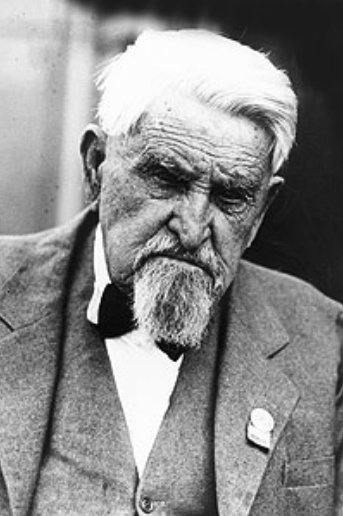
Charles “Charlie” Goodnight cast a large shadow over the American West. He fought in the Civil War. His name is half of that of the 2,000 mile Goodnight-Loving Trail blazed by him and Oliver Loving (and later John Chisum) when they drove the first herd of cattle from the Texas Panhandle, through Colorado, to Wyoming. At Loving’s request, Goodnight transported his body from New Mexico to Weatherford, Texas, for burial after Loving’s death (an event depicted in Larry McMurtry’s “Lonesome Dove”).
Goodnight served in the Texas Rangers and was a key player in the recapture of Cynthia Ann Parker from the Cheyenne. He later crafted a treaty with Cynthia Ann’s son, Chief Quannah Parker, who himself was a key player in the Second Battle of Adobe Walls in the Texas Panhandle. A fight notable, among other reasons, for the single shot made with a .50-90 Sharps rifle by Bison Hunter Billy Dixon which unhorsed a Cheyenne warrior at a measured distance of 1,538 yards. Goodnight was one of those whom Western writer Louis L’Amour referenced when he characterized the term “Western Myth” as comprising “The hard-bellied few who made it safe for the soft-bellied multitude to follow.”
Pioneer, soldier, giant of the Old West, Charlie Goodnight breathed his last in Phoenix, aged 93 years, in 1929. He lies at rest near Amarillo.
All that said, the proper expression for wishing someone a pleasant night is “Good night”. Two words, as succinctly expressed by Frank Dauenhauer, former Technical writer and editor at Eastman Kodak Products and Services (1960-1991):
“‘Good night’ is grammatically correct. ‘Goodnight’ is not. Say ‘Good Night’ to ‘Goodnight’.”
 Chalk Dust
Now do Jim Bridger, Demps.
LikeLiked by 1 person