Back in the late 1970s I was sent on TDY (Temporary DutY) to West Fort Hood in Texas to be Fort Benning’s Infantry School Liaison to TCATA (TRADOC Combined Arms Test Activity) to test the target hardware and establish the procedures that would become the heart of the NTC (National Training Center) at Fort Irwin, California.
Bear with me if it seems that I’m puffing my chest regarding this, because I am. There were four of us – a Major, two Captains, and myself, a Lieutenant, as well as our support staff, who were the pioneers of what’s in place at Irwin today. I remember breaking the ice on the frozen puddles surrounding the target mechanisms to gain access. I remember heating C-rations in a sink filled with hot water at the BOQ (Bachelor Officers Quarters) for supper. I definitely remember the tests involving combat units and their live firing of machine guns, tanks’ main guns, TOWs (Tube-launched, Optically tracked, Wire-guided missiles), Dragons, etc. And I remember the feeling of satisfaction when it all successfully came together. I get that feeling still today whenever there is mention of the NTC. For that small group that accomplished so much among the blowing dust and rolling sagebrush of central Texas during those months, it is a legacy.
Back up to graduation, the summer of 1975. I drove my shiny, new, Pontiac Firebird Formula 400 from West Point to my parents’ home in Glendale, Arizona. With me was a fellow Judo Team member who I was dropping off at his home in Pasadena, Texas. “Stinkadena”, he told me, was the colloquial term because of the odor of the oil refining taking place. At his house, when his sister and I laid eyes on each other, something clicked. We both instantly knew there would be a “relationship” in our future.
I remember making a trip to Gilley’s before the movie Urban Cowboy was little more than a script writer’s dream. My fellow Judo Team member was irritated because I insisted we take his sister with us. After reporting for duty at Fort Benning I would go to Pasadena as often as possible. She would visit me at Benning when she could. There, I was allowed to board her plane when it landed in Columbus, Georgia, and I would carry her off. She had been a proficient equestrian, a horse jumper, now paralyzed from the waist down due to an automobile accident. My carrying her to her own wheelchair proved more expeditious than the airlines’ multiple chair transfer procedure. She and I eventually took divergent paths and, last I’d heard, she’d married an engineer.
Fast forward to 1981, after the army and I had parted ways. Texas Instruments hired me as a software developer and moved me to Lubbock, home of Charles Hardin “Buddy” Holly and Texas Tech University.
I absolutely loved that town. I lived within walking distance of South Plains Mall, the only mass shopping place in the area at the time. There is a single highway, Texas 289, which encircles Lubbock. Once you cross it on your way out, you’re definitely out of town. You’re now on the High Plains. In fact, Lubbock is located in the eastern part of the Llano Estacato – the Staked Plains.
I don’t understand why Texans choose to mangle the melodic pronunciation of Spanish names. Llano isn’t LAN – oh, it’s YAWN – oh. Bexar county isn’t BEAR county, it’s Beh – HAR, roll all “r”s. Texas itself should be Tejas, or TEH – haas (“friends”). Amarillo? Ah-mah-REE-oh (sorry, George Strait), it means “yellow”. The Panhandle town was named after the color of the sand in the creek that was its original boundary.
In the spring there is a constant wind – constant, not gusts – of around 20 miles per hour which blows into Lubbock off the surrounding plains. It lasts for several weeks with few breaks. I remember it making the act of going for a run especially challenging.
When TI’s personal computer endeavors went belly-up, some of us were moved to the Dallas/Fort Worth area. I hated it there. For one, it was too crowded. I recall driving home from work one night when traffic was at a standstill for so long that I pulled onto the shoulder of the road and turned off the engine so that I wouldn’t run out of gas. Unlike Lubbock, you could drive for hours in D/FW and not get out of town. Once you did get out of town you wouldn’t know it because there were still buildings everywhere and the terrain hadn’t changed.
I ended up settling in the suburb of Garland, in a new home, about a mile from a gun range. The sound of gunfire throughout the day was reminiscent of Fort Benning and provided a comforting familiarity. After too many years in the “Metroplex”, when the opportunity presented itself, I made the move to Austin.
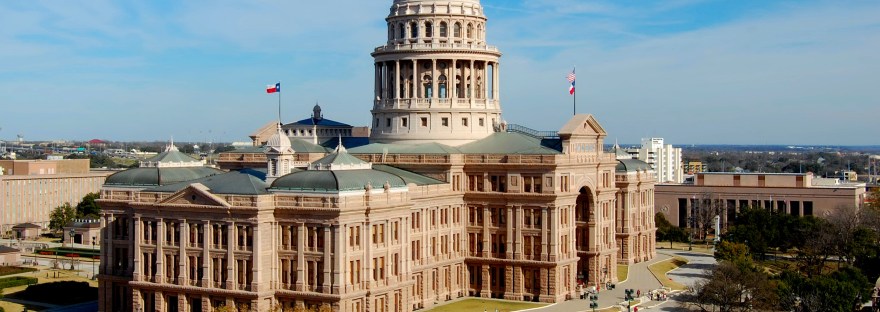
A three hour drive from Dallas/Fort Worth, Austin and “The Hill Country” were wonderful. I embraced the theater community, performed on a number of stages, and finally took some long-overdue Shakespeare classes. At night, I would drive to the Capitol and wander its halls. You could do that back then. To me, the Capitol represented everything that defined Texas. It was the heart of the State.
The feel of Austin was different…slower, more laid-back. Texan. My office was just above the Pennybacker Bridge, you can see the bridge today as it’s being featured in a number of automobile commercials. The County Line Restaurant (there was only one back then) served up true Texas Barbecue. It was delicious. They also had a “Governor’s Table”, you could sit there with the understanding that if the Governor came in you’d surrender the table and move to another.
Every Friday I would go to Houston’s restaurant and have a medium-rare Kansas City Strip with a couple of glasses of Riesling (I know, white wine, red meat…) I would drive to San Antonio to pay homage to those who’d fought at the Alamo, to visit The Riverwalk, and to have a meal at the revolving restaurant in the Tower of the Americas. I drove through an Austin neighborhood one night and marveled at the lifelike statue of a deer lying at rest in a resident’s yard. The statue impression disappeared when the deer moved.
Despite all this, whenever I envisioned buying a home in Austin and making the move permanent, I would see a Saguaro cactus in my mind. The desert of Sonora was calling me home.
So, after more than two decades, I went home. Home to Arizona. But not before making a visit to old Fort Griffin. More specifically, “The Flat”, the two-fisted army town which sprang up outside the fort. A town so wild that at one point the fort’s commander placed it under martial law, where brawling occurred on a regular basis, and where “Big Nose Kate”, Mary Katherine Horony Cummings, helped her lover, John Henry “Doc” Holliday, escape vigilante justice by breaking him out of jail at gunpoint. Outside of the remnants of some stone walls, there wasn’t much of the town left when I visited. But, as always, if you were quiet, you could hear the whispering of the ghosts.
—
Dempsey 🌵
 Chalk Dust
Great memories Demps….as a current Texan I read your post with a smile on my face: well done!
LikeLiked by 1 person
I’m glad our paths crossed during your journey through Texas. Last weekend, Clara and I drove back to 360 and into the parking lot of the Prominent Point building. I narrated fading memories of our days at Prism Solutions.
Of the other notable colleagues from that time, you are the one I remember the most, and quite fondly. I was probably 15 or so years younger, and by comparison, still “wet behind the ears” in many ways. I realize now that I was listening to every word you said, and taking it to heart.
Be well
LikeLiked by 1 person
We had some times, Dan! Thanks very much for your kind words. I hope you’ll look me up if you’re ever out this way and I promise to do the same. We have a lot of catching up to do.
LikeLike
Nice memories!
LikeLiked by 1 person
Enjoyed it…thanks.
LikeLiked by 1 person