
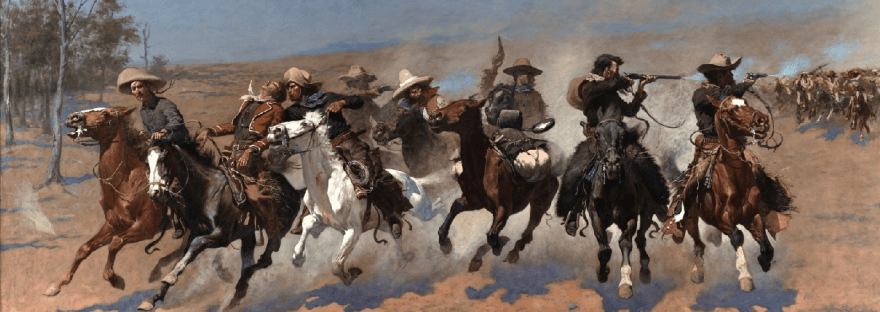
It was heating up out here in Arizona. We were expecting our first 90° day, on the way to the summer’s triple digits. I was reminded of how nice it is to be able to get into my climate controlled Dodge Challenger and go anywhere, at any time, in comfort, a comfort bordering on the obscene. How nice.
How nice. And how sad.
Not long ago I had a conversation with a West Point classmate regarding how soft we’ve become. Wouldn’t it be nice, for a change, in the few times we wander into the summer heat that instead of wearing shorts, T-shirts and flip-flops, we wore long-sleeved cotton, linsey-woolsey, or wool shirts, full length woolen or jean trousers (depending on the era) and high boots? An outfit that wore hard, protected us from the sun and foliage as well as rattlesnake bites. Complete the ensemble with a wide-brimmed Stetson to defeat the sun’s scorching rays.
Yes, it would have been hot and sweaty. Sure, it would have been uncomfortable. But when it’s all you know and you have no frame of reference for air-conditioned comfort, it becomes the norm.
Wouldn’t it have been great to know that not only does the desert want you dead, the indigenous people do as well? At the end of every day you would feel alive, instead of taking that fact for granted. The older we get the more we become aware of our mortality and that’s a fact that would do nothing but enhance life if we were to be aware of it much earlier.
How grand it would be, as a West Point graduate of the time, to go to work for the Army of the Territory as a scout, to fight the American Indian. Not out of hatred but out of doing your job and knowing you were going man-to-man with a true warrior. If you were killed, what a way to go, instead of enduring late-life dementia while a girl your granddaughter’s age changes your dirty diaper. You would go down striving your most earnest against a hardened fighter who was as fervent in his opposition as you were in your incursion. While messy, it would be a gallant death at the hand of a worthy opponent. One, once peace was established, you would unhesitatingly salute and call “brother”.
Yes, death would likely come much sooner. But that would be alright because you would have lived a ten-pound life crammed into a five-pound lifetime.
What a wondrous experience to stop your horse at the edge of the mesa, feeling him shift his weight beneath you as you hold your reins loosely in one hand, your gun hand free. You peer down the escarpment and drink in the wild, deadly, and beautiful vista below you, knowing you were one of only a handful of humans to have been blessed with the privilege of that wonderful sight.
I remember reading how Texas Ranger Jim Gillette, in his book, “Six Years with the Texas Rangers”, lamented the loss of the endless seas of wildflowers and prairie grass that he first saw in West Texas from horseback. The book was published in 1921.
Like the Texas wildflower, the southwest desert is fast fading. Eventually wild Sonora will disappear completely, having been forced to make room for human incursion.
A romantic view, you say? Of course. We live our lives in pursuit of romance, not our everyday reality. Romance does exist, but it’s elusive. We know it when we find it. We’re fools if we fail to embrace it.
~ Dempsey 🌵
Image: “A Dash for the Timber“, Frederic Remington, 1889
 Chalk Dust
Really enjoyed the writing Demps!
LikeLiked by 1 person
I couldn’t agree more, Dempsey. Not a naive, romanticized view at all. Preserving the culture and tradition of the Old West is the least we can do. The land is not lazy; it is we who are lazy. Excellent piece written by one who gives the West its due.
LikeLiked by 1 person
I will admit to preferring that I carried a Henry while the Indian was left to his native arms. The longer reach I have to improve my odds, the better I feel about that outcome. But, I do admire the salute of a worthy foe. Too often these days, I feel I would withhold that salute as our current enemies do not deserve our moral respect. Apparently, some in our country are taking that feeling back 160 years, though our predecessors did not see it that way.
LikeLiked by 1 person
Thanks for your kind comments, Charmaine.
LikeLiked by 1 person
When our family moved to Phoenix in 1956, it had about 350,000 residents. Scottsdale was closer for shopping and other business, and the hitching posts and water troughs for horses were not ornaments but necessary for some customers. The blacksmith shop was always busy. The air was cleaner but dustier, and the sunsets spectacular!
LikeLike
Better days…
LikeLike