I was in somewhat of a rush to return to Arizona from Virginia when I saw the sign. I’d been gone longer than what I had allotted for the trip. Then again, I had read about this battle on several occasions, ever since I was a kid, and both George Custer and his boss, Phil Sheridan, were alumni. Much is known about both of these men, but of special interest to me as a fellow West Point graduate was something I’d learned recently about Sheridan. From the National Parks Service Web site:
“It is known that Sheridan received his early education in Somerset [Ohio] and entered the U.S. Military Academy at West Point from that town in 1848 after lying about his age. His career as a cadet got off to a shaky start when Sheridan, who was known for his hair-trigger temper and nicknamed ‘Little Phil’ due to his shortness—he stood five feet, five inches tall, with a huge torso and short, bandy legs—assaulted an upperclassman, which resulted in his suspension for one year. He graduated in 1853, ranked thirty-four in a class of forty-nine.”
At a speeding 82 miles per hour the exit was coming up fast so I made a quick decision: easing my foot off the throttle I let the Challenger slow and turned it onto the exit ramp.
So began my foray back in time. Back toward that winter’s day of November 27, 1868, when Custer and the 7th Cavalry attacked the village of Cheyenne Chief Black Kettle under Sheridan’s mandate of “Total War” with orders “to kill all the warriors, capture all the women and children, destroy all camps and material goods, and kill all the ponies.” Back when Custer left the field without knowledge of the disposition of his second in command, MAJ Joel Elliott, an act that’s anathema to the military of today. (From the NPS Web site: “Elliott without notifying Lt. Col. (SIC) Custer, called for volunteers to follow him downstream and chase Indians escaping from the village. When Custer prepared to depart, Elliott’s detachment of seventeen men could not be found. Two weeks later General Sheridan and Lt. Col. Custer discovered the mutilated bodies of Major Elliott and his men two miles downstream from the battlefield.”)
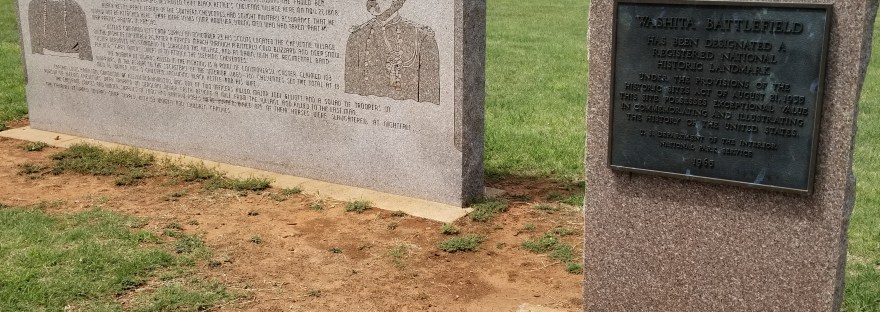
Here is some of what I saw at the site of the Battle of the Washita.
~ Dempsey 🌵
 Chalk Dust